Showing posts with label Arduino Due. Show all posts

Friday, January 13, 2017

Arduino as a Microcontroller Reference Platform

The Arduino line of microcontrollers has, arguably, been the spark that brought programmable hardware to Makers worldwide. This article takes a look at how Arduino furthered the use of microcontrollers and how it is important defining standards today.

Arduino dates back to Hernando Barragán's design of the Wiring platform in 2004. In 2005, Massimo Banzi, with David Mellis forked the Wiring source code and started running it as a separate project. Arduino use grew through successive product releases including the Arduino Diecimila, Arduino Duemilanove, and the baseline Arduino Uno board series (in its third revision). The evolution set the Atmel ATmega328P microcontroller in the Uno to become the microcontroller standard of its time.
The Arduino Uno R3 (photo via Adafruit)
The ecosphere of Arduino, consisting of the circuit board and Arduino Integrated Development Environment (IDE) became very compelling for developers. Many software libraries were created to extend Arduino software capability and hardware connectivity. This growing capability launched the ATmega328 into many project designs. The success of the Uno board design led to other companies and makers to make Uno compatible boards based on the '328. The price of the Uno was set at the time at $35 and it did not go on sale often, requiring an investment on the purchase of each board.

In expanding the Arduino product line, the Arduino team introduced other boards based on newer microcontrollers. Some have been more widely adapted into maker designs than others. Many software libraries required changes to support different microcontroller architectures.

The development of the Atmel ATmega328P has evolved from the ATmega168 and smaller ATmega8, which all use the Atmel's AVR architecture. The '328 chip runs at a nominal 16 MHz (on the Uno) with 32 kilobytes of flash memory. This is modest by computer standards, but this chip equalled much of the industry when it was introduced.

The Arduino team, in looking for better designs, introduced the Arduino Leonardo. Leonardo was based on the Atmel ATmega32U4 microcontroller with the same 32kB of flash at 16 MHz. The chip was mostly compatible with the '328 but also had the feature of native USB controller onboard, eliminating the need for a separate USB chip on boards such as Uno. The Leonardo was less popular than the Uno but found some interesting uses due to features not found in other microcontroller boards. The native USB was very popular with other company/Maker board designers who, to this day, use the ATmega32U4 and the Leonardo software to make compelling microcontroller boards at a low cost.
Arduino Leonardo (photo via arduino.cc)
Sadly the Leonardo has been discontinued by the Arduino team but the use of the ATmega32U4 lives on in many new designs.

The Arduino Due was the Arduino team's first commercial step into the Atmel SAM architecture chips. SAM features an ARM processor, capable of speeds much higher than the Uno/Leonardo 16 MHz and also capable of more flash and other compelling features. The Due, being the first Arduino SAM board did (has) not find (found) a wide following in products or maker projects but it did (has) start software migration of the Arduino software base to use non-AVR chips. (Note: While announced as discontinued, they are still available via arduino.cc).

Note: Yes, I am skipping some Arduino releases here and there which are also AVR based designs.

The Arduino Zero, beta tested in 2014 with release in 2015, has become the new tier for microcontroller designers. Based on the newer Atmel/Microchip SAMD series, the board provides the SAM higher clock rates, ARM core, and a much smaller size.

Microchip recently bought Atmel, hence the processor provider name change.

The Zero has not supplanted the venerable Arduino Uno, yet, but the day draws closer where there are no arguments for selecting the more modern chip. Variants are smaller and much easier for manufacturers to incorporate. The Arduino Zero software is defining a new generation of compatible boards, especially from Adafruit.com which is revising a number of their microcontroller boards to use the SAMD chips. The third party boards are often less expensive than the Zero as the Zero design uses an additional debug hardware chip not used by most hobbyists.

It is conceivable that Microchip may look to discontinue AVR production through price hikes, leaving the SAMD and possibly their own PIC lines more widely available.
Arduino Zero (photo via Adafruit)
Where does the flood of Arduino compatibles leave the Arduino team?  Actually in a fairly good spot. The team are the Research and Development group foremost, providing both the low level chip firmware and the ever more powerful IDE to tap into new chips. The Arduino team continues to bring forward very compelling boards in different form factors: the Arduino Zero, MKR1000, and MKRZero boards have a great amount of capability at a cost lower than the Arduino Uno of old.

The Arduino team also has been collaborating on non-Microchip boards, including Arduino Yun, Arduino 101, and others. They also are important in expanding both the capabilities of the Arduino ecosphere and in partnering with companies other than Microchip to include Intel. The ability to easily use new, powerful microcontrollers and Linux based processors only benefits the ability of both companies and Makers to use the newer processors.

We all can look forward to the growth of the Arduino family tree, which has grown from a seedling over ten years ago. The innovation of the Arduino team has enabled people worldwide to harness some incredible hardware in making incredible products.

Tuesday, February 23, 2016

Arduino.cc Discontinues Selling the Arduino Due

Photo credit: Adafruit

In a post on the Arduino.cc developer's email list, team member Massimo Banzi stated on February 23, 2016:
When we rebuilt our manufacturing network we took the chance to redesign the product line to simplify it. We also had to decide the sequence of release giving priority to products that are most popular. Having said this we see an interest for the Due from the resellers and we’re working on a solution. In the meantime the SAM core is still supported and it’s getting updated even if we’re not selling the hardware.
He goes on to clarify:
Arduino/Genuino doesn’t sell the Due full stop.  There is a number of companies using the Arduino name and logo around the world who make boards that are called Due. As I said we’re evaluating an improved product for this market segment. 
So:

1) Software Support: No worries, the Arduino.cc IDE has support for even ancient Arduino versions listing "Arduino Duemilanove or Diecimila" and "Arduino NG or older" in the current IDE.

2) Due Chip: may possibly be on future Arduino.cc products but not the exact Due board.  Atmel also makes many variants of their chips allowing board designers to have flexibility in choices.  Time will tell.

3) Due Board: Will not be sold by Arduino.cc or under the Arduino or Genuino brands.  Any new boards will most likely be from Arduino.org or Chinese clones. The ecosphere is still free to sell derivative Due compatible boards which should be around for quite some time.

The Arduino.cc website still lists the Due in the shop but "Out of Stock".  Banzi posted the website will be amended soon.

Thoughts?  Does this complicate your decisions or do the capabilities of new boards like Arduino Zero and Arduino 101 fill the void?


Saturday, June 8, 2013

Latest Arduino Due Pinout Diagram Released

Rob Gray aka the GRAYnomad released an updated color pinout of the Arduino Due.


Go to the Arduino forum to get copies in various formats.

I had informed Rob of a minor issue, possibly others had too.  This version would appear perfect.  Rob is the original diagram creator with Alberto "Pighixxx" running with the concept to extend the diagram count to most other Arduino platforms and many other circuits.

Personal rant: I still consider the Due a beta/experimental platform.  The software support is no where near what it needs to be to be up to the level of the Uno, Mega, Teensy, and other platforms.  The software errata is also rather high and the development environment is not well polished.  If this chip represents a new plateau in the Arduino, the effort must be made to fully bake it, then let the community put the frosting on.  Going half way then releasing to the community has caused a fair amount of problems and slowed adoption considerably.  My rule of thumb - if Adafruit has not supported the ecosystem in some way, the system may be more of a pain than it should be.  That may be simplistic but Limor Fried is a saavy engineer and businesswoman so her opinions go a long way in hobby design.

Shields: It would be very good to get some reference shields out that detect the IOREF voltage and adjust accordingly (3.3 volt or 5 volt).  I do not count the wifi shield, it is too complex to be used as a reference for designers to build shields with I/O voltage adjustment capability.  And the GSM shield is also very complex and does not have official Due compatibility (possibly due to software issues).

Current ecosystem: With the release of the Beaglebone Black at the $45 mark, the pressure is back up.  The old Beaglebone was a bit expensive to challenge the Arduino clan.  But the BB Black has a great deal of capability and undercuts the Due by $5.  The lower-end Arduino clones like the Teensy 3.0 use ARM Cortex chips at Uno like prices (~$25-$30) often with extended software support out of the gate (see Kickstarter).  The choices are harder (or better) than ever.

Tuesday, May 7, 2013

Arduino Competition Causing Pricing Pressure

The assault by the microcontroller industry on the $30 Arduino Uno and its siblings is in full effect.

Once something becomes popular, people want them but prefer them cheaper, better, or faster.

The Arduino team has been working on this with mixed results.  The bigger and faster Due is still in a sort of beta with very poor software support compared to the mainstream Uno. The lack of add-on boards supporting the software and lower operating voltage has severely limited widespread adoption.  Better - in the form of Leonardo - has been very quiet except for the adoption of the chip and bootloader into many competing products (some rather good).  The Esplora is now carried in stores beyond the Radio Shack launch partner but the Esplora forum on the Arduino site is crickets, no activity.  All of this, with prices showing very little flexibility in the last year.  Those companies that priced the Uno at $35 have tended to lower the it to a fixed $29.95 price point.  Only Microcenter has shown flexibility, pricing the Uno down to $15 before relenting and having it bounce back to $25.  Finally Sainsmart has lowered their Arduino Mega R3 board down to $16.99.

Competition

1. Kickstarter - it seems everyone can and has come up with Arduino clones in every shape and size.  The trend though is than they are nearly always less expensive, the tiny ones very much so.  Keep an eye on the Spark Core that is red hot.

2. Clones using better chips - the Teensy and recently a line of Freescale processors have offered more capability at cheaper price points.

3. The big boys - yes the Raspberry Pi is not an Arduino competitor but adjunct, yes?  Yes and No.  Some of the Arduino's educational sales may be on hold while they learn about the Pi.  Boards like the Coocox Embedded Pi allow a Raspberry Pi to act as an arduino with shield support at an Uno price.  Finally the wildly popular UDOO combines Arduino Due and 4 times the Raspberry Pi power into one board.  The market also is receiving price pressure from Android and even small PC board makers with prices from $50 to $100.

Will innovation keep the official Arduino platform at current prices or will we see pressure to move manufacturing to Wales, UK (unlikely).

Monday, April 1, 2013

Due Alternative - SainSmart Land Tiger

Looking through the SainSmart site, I noticed a Cortex-M3 board with many features built in.  And it's priced at $60.99


The Land Tiger development board on-board USB emulator, supports USB 2.0 Device, dual CAN interfaces, RS-485 interface functions. It has many of the features that the Arduino Due chose to leave off their board (like Ethernet).  The touchscreen interface is a nice touch.  And it would appear that it uses the Due version of the Arduino Due for programming.

Features:

  • Cortex-M3 512KB on-chip Flash, to support ISP and IAP
  • 64KB SRAM
  • processing rates 100MHz, and includes a support eight areas of memory protection unit (MPU)
  • Built-nested vector interrupt controller
  • AHB multi-layer matrix with 8-channel DMA controller, general-purpose (GPDMA)
  • support the SSP, UART, AD / DA, timer, GPIO, etc., can be used for memory to memory transfers
  • standard JTAG test / debug interface and debug serial line and serial line tracking port option
  • simulation trace module supports real-time tracking
  • 4 low-power modes: sleep, deep sleep, power-down, deep power-down
  • single 3.3V power supply (2.4V - 3.6V)
  • Operating temperature: -40 °C - 85 °C
  • non-maskable interrupt (NMI) input
  • On-chip integrated power-on reset circuit
  • Built-in systems beat the timer (SysTick), to facilitate the operating system migration.


Onboard Resources:

  • 2-Way RS232 serial interface (using the straight-through serial cable, serial port support them all the way ISP download)
  • 2 CAN bus communication ports (CAN Transceiver: SN65VHD230)
  •  RS-485 communications interface (485 Transceivers: SP3485)
  •  RJ45-10/100M Ethernet network interface (Ethernet PHY: DP83848)
  •  DA output interface (USB sound card can do experiments on-board speaker and speaker output driver)
  •  AD input interface (adjustable potentiometer input)
  •  color LCD display interface (which can take 2.8-inch or 3.2-inch color TFT 320X240)
  •  USB2.0 Interface, USB host and USB Device Interface.
  •  SD / MMC card (SPI) interface (available with FAT12, FAT16, FAT32 file system)
  •  IIC Interface (24LC02)
  •  SPI serial FLASH interfaces (AT45DB161D)
  •  2 user keys, 2 function keys and the INT0 Reset button, 8 LED lights
  •  1 Five keys to enter the joystick (Joystick)
  •  serial ISP download function (no need to set jumpers), the standard JTAG download, simulation debugging interface.
  •  integrated USB emulator: simulation and debug capabilities to support online and support KEIL, IAR and other mainstream development environment.
  •  optional external 5V power supply or USB input to provide 5V power supply.
  •  leads all the IO, user-friendly external circuit to the secondary development of other applications.

I really like it when a board/system designer includes enough of the touches to encourage developers rather than throwing them to the wolves.  This one is rather cool.


Now if SainSmart wants a bigger review, send one over ;-)


While I did post an April Fools post on Google+, this is not an April Fools post.

Wednesday, February 20, 2013

Arduino Due Hardware SPI

The Arduino documentation for the Due board has extended library calls for hardware SPI, handling up to three devices.  The extended documentation is good but not overly complete.  In learning the device, I have found a number of things that may clarify the library in practical use.

The library for hardware SPI is SPI.h.  It defines different functions than the AVR Arduino library.  This is due to expanded capabilities described below.  If you port code from old programs, you will have to edit calls to new syntax.

Pins: Hardware SPI MISO, MOSI, and SCK pins are only on the SPI header (not to be confused with the ICSP header which is different on the Due).  See below.
What this does not show are the digital pin numbers.  They are not needed for SPI library calls but will be used later so we should know them.  The Arduino IDE has predefined variables MISO, MOSI, and SCK (something not readily known or documented).  If you use a short sketch to print them to the serial monitor, they are: MISO - Digital Pin 74, MOSI - Digital Pin 75, and SCK - Digital Pin 76.

Instead of one Chip Select (SS) pin, the Due supports three.  These are hardware Digital Pin 10 (SPI-CS0), Digital Pin 4 (SPI-CS1) and Digital 52 (SPI-CS2).  These pin values are used in the Due SPI library calls to determine which hardware SPI device you are addressing (up to three at the same time).

Clock settings: different from the AVR Arduinos as well.  The function call is:
  SPI.setClockDivider(SS, divisor);

The preset values of SPI_CLOCK_DIV2 etc. from AVR days are not defined. The divisor is an integer from 1 to 255. You calculate the clock rate as follows:  The Due system clock is 84 Megahertz.  The divisor is the number you divide into 84 MHz to get your desired clock frequency.  So common values would be:

Divisor   SPI Clock Frequency
84          1 MHz
42          2 MHz
21          4 MHz   (Default value, usually what AVR SPI bus uses)

It appears there is no way to get 8 MHz as the function takes integer divisors. (Need to double check this, very little documentation).

For now, it would appear that setting pins using pinMode and digitalWrite are not allowed.  The comment on the reference is: once SPI.begin() is called, the declared pin will not be available as a general purpose I/O pin, so do not set pinMode for the SPI lines if also using SPI library calls.

Finally, the hardware SPI library is only for 8 bit data values (send and receive).  If you need 9 bit SPI as is used on some graphical displays, the hardware library will not work.  But do not fret, there are some that have used low level calls to do software SPI which is capable of 9 bit SPI, I'll look into that next.


Monday, February 18, 2013

Arduino Due SPI Display - Nearly Defeated

I have been working over a week on trying to get an Adafruit SPI driven display to work on the Arduino Due.  No, it still does not work and I'm not happy.
The Due SPI interface has fairly incomplete documentation.  From the clock divider function call having do documentation on divisors to supposed support for more than 8 bit transfers (but zero documentation on that).

So writing an interface with native function calls is pretty much moot at this point.

On the Arduino Uno, most high performance code manipulated processor registers to get the speeds necessary for pumping out the data to a display fast enough to see in real time.  It turns out direct register calls work with Due also.  The best example is the gLCD Library by Tom Carpenter documented in this forum post.  Pretty good stuff but once you get to AVR/Uno normal and high speed, Due normal and high speed, the complexity rises exponentially.

My work has been to splice the initialization and display write code into the Adafruit HX8340B library.  Not an easy task after mastering the Due blink sketch.

First you have to make the original code Due compatible.  This involves compiler directives to detect a Due target platform.  The Due does not have some features of the originals.  The following is to move data that an AVR places in Program Memory (PROGMEM) into the more ample RAM of the Due (and the fact that PROGMEM is not handled like the AVR on the Due if at all):

#ifdef __SAM3X8E__
#define PROGMEM static
#define pgm_read_byte(x)        (*((char *)x))
#define prog_uchar uint8_t
#else
#include <avr/pgmspace.h>
#endif

This should work with #ifdef _LIB_SAM_ also but I have issues with that consistently working.

Then there is adding code for SPI again with #ifdef modifiers to put in Due code instead of AVR code where necessary.  Pretty complex.

Where I have bogged down is:
  1. Are Arduino SPI calls necessary for direct register (probably yes), so is a divisor of 21 for 4 MHz (84/21=4)?  No documentation.
  2. The gLCD library and Adafruit library have different handshakes for starting to enable the signal lines. I'd trust Adafruit did theirs right.
  3. Setting pinMode for SPI data lines causes the code to hang.  Are these needed and if so how to not have them hang.  A real debugger would help.
So at this point I'm setting the work aside.  I can post some code on Github if anyone wishes to review things.

If I get creative, I'll probably do two things:

  1. Fire up my DSO Nano scope - I haven't used it yet but I should to see what pins are doing.  An 8 bit 100 MHz logic analyzer would be preferable but I don't have one.
  2. Start at the basics - get just the Due code running - probably by starting with basic SPI oerations, then building on that.  It would be better to have a real simple SPI device to do this on that gives clear indications of operation rather than the complex display I have.  Ideas?

Excellent Arduino Pinout Diagrams

Several high quality color pinout diagrams have been posted to the Arduino forums.  These are very helpful for knowing the basic and advanced functions of Arduino boards.

The first to be posted was for the complex Arduino Due (above) by user Graynomad.  Then user Pighixxx used similar layout to do diagrams for the Uno, Mega, Esplora and more.

For readers, I link to the forum posts for various diagrams.  This allows you to get the latest version in case of revisions (the forum is keen on spotting any problems which keeps the quality of the diagrams very high).


Also with the Uno, Pighixxx laminated a printout and mounted it on a plate and mounted a real Uno which makes a great prototyping plate (probably more detailed than a beginner might want, I would say a great target would be for technical or college level classes).

One doesn't need this level of detail for their first Arduino project but for midlevel to advanced work, these are wonderful and bring together information it could take hours to research.  Thus you have more time for actual experimenting (and debugging).


Thursday, December 6, 2012

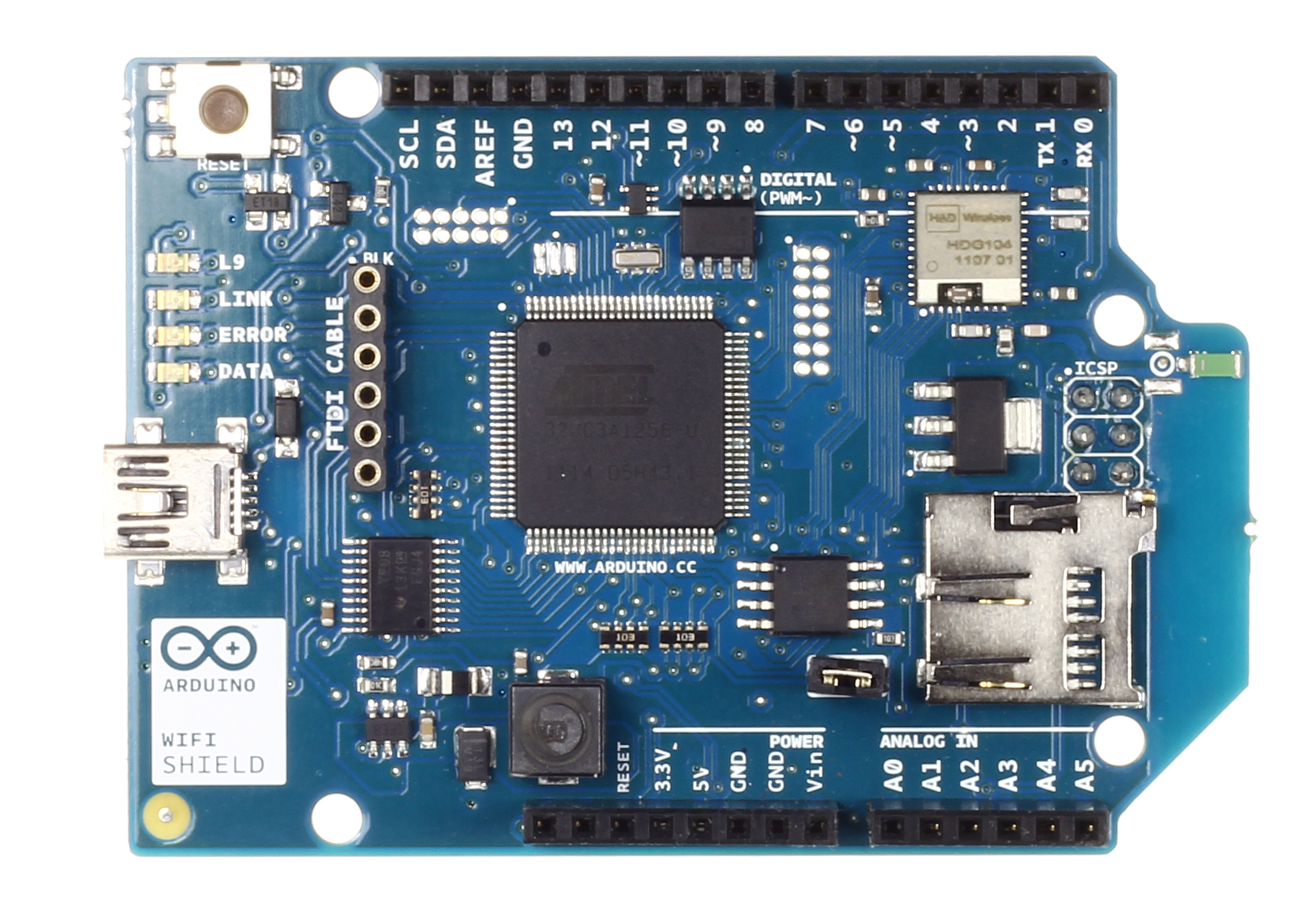
Why are Arduino Wifi shields soooo expensive?

Makers are cheap.  They are frugal and recycle and repurpose but overall they do not want to spend too much money.  So why are the Arduino(tm) shields that connect to wifi so expensive?
The new Arduino wifi is in all rights nearly as powerful as an Arduino Due but costs a whopping $85.  If you have a $30 Arduino, strapping this on is like putting a V8 in a baby Fiat.

Ok, time to turn to the 3rd parties.  A history of boards show high prices also - the Sparkfun WiFly is $70.

Try China?  Itead Studio's board is $60.  The board at Seeed is $60 also.

And all these things are only 802.11 b/g and many require an open router.  Hello??

What to do?  Make one.  I'm thinking the new Electric Imp at $30 and a interface shield at $20 and that's $50.  And the Imp has a Cortex processor on-chip itself.  I think a $30 solution would match the Arduino better but that seems like wishing.

The only other thought I have is some Arduino board with a USB host and can handle a cheap PC type USB wifi stick.  I haven't seen anyone use such with a microcontroller, maybe someone will do that for the Due?

Friday, October 26, 2012

How Much Time for the Arduino Mega?

Every several days I browse eBay under keyword Arduino to see what the universe of parts may be currently offered.  I didn't know it when I started, but it is clear now that over time one can deduce what the state of the market is by observing the trends.  That coupled with the latest news provides me the insights for today's post.

The Arduino Uno style clones are growing in frequency at lower price points.  I have seen two styles of Adafruit motor shield clones at about half the genuine price.  The Ethernet shield clones are below $15 which is rather amazing as the official model is three times that.

But today, I focused on the Arduino Mega (current retail $65).  With the announcement of the Arduino Due, it seems there is a marked reduction in the prices the Mega and its clones are commanding. The Arduino group has not announced the Mega's fate but with the Due offering significant performance and capability improvements over the Mega at a lower price point, the Mega will most likely be discontinued.

While I could see a repricing of the Uno at $25 and the Leonardo at $20 in comparison to the $49.95 Due, I have a hard time seeing Italian manufacturing accommodating this well as the margins diminish.  This may be possible though - the Raspberry Pi is being manufactured by Sony in the UK for $35, so the low parts count Arduinos could be still made in the EU at affordable prices.  I would say if the Mega stays part of the Arduino lineup, a price point above $32.50 would be rather hard to sustain.  The clones are running $20-$26 so a price of $29.95 would be better.  But then again, will Makers keep using the board when the Uno and Due bookend it?

Monday, October 22, 2012

5 volt systems are the CRT, 3.3 volt is the LCD

Like CRT to LCD, standard def television to HDTV, DVD to BluRay, the "king of the hill" electronics change, sometimes slowly, sometimes rather fast depending on many factors.  Consumer adoption sometimes drives the timeline.  In electronics it can often be parts availability.  If the chip makers discontinue designs, the electrical engineers must change their designs or maybe discontinue the product.

5 volts has been the electronics standard for powering chips for decades.  Since the 7400 series discrete logic chips, you had to have 5 volts to power devices and talk between chips.

But 3.3 volts (often abbreviated 3V3 or 3v3) has been growing strong in recent years.  This has accelerated with mobile electronics growth, lower voltage reduces power and heat loss.  Many popular systems are now 3 .3 volt including popular XBee radios and many flavors of microcontrollers.

But 5 volt chips do not talk to 3V3 chips well.  You can use a number of engineering tricks such as voltage dividers or FETs or go elegant with a level converter chip in between.

Many of the new systems are coming out in 3V3 power including the Raspberry Pi (internally, 5V from the tap), and the new Arduino Due (the new spec sheet has a warning to ensure folks know this fact).

It certainly looks like 5 volt designs will continue to wane.  It may be awhile before it joins VHS tapes and CRT displays - you should start to plan your designs for the 3.3 volt future.
 

Due Day

Today's the day that the first retailer that I have seen has said they are actually selling the Arduino Due - Adafruit.  In an earlier post I stated that the 32 bit microcontroller market, one that blurs the distinction with computers like the Raspberry Pi, is crowded.  My final analysis was the product had to be priced right, under $50.  And I seemed to have hit it, with Adafruit pricing an assembled unit (with headers) at $49.95.

They had quantity discounts listed up until 11:25 a.m. but pulled those, perhaps due to limited quantities at introduction.

With the final feature set now being released, probable software like wav/ogg file generation, second USB host connection, the product does seem to hit a market others do not have covered.

I hope shield compatibility works out better than the Arduino Leonardo, which has been very problematic (although you can buy an extra TransmogriShield from Sparkfun to rearrange connections for an extra $14.95).

The Maker community will have these in hand soon, I sincerely hope some very cool projects and add-ons/shields come out in short order.

PS If one wants to make their own compatibility between a classic Arduino shield and other products, check out this Kickstarter for a cool board.

Wednesday, October 17, 2012

Are Arduino Unos Coming Down in Price?

In a previous post, I discussed the expansion of the microcontroller ecosystem (something predictable for a popular segment, call it Moore's Law if you will, I didn't).  I admit I do not have the free time to do thorough market analysis on products but I keep my eye on things and I think I have spotted a trend.  Arduinos appear to be dropping in price.

The Chinese knockoffs open source compatibles have always tried to undercut the official Italian boards but often not by much.  The compatibles appear to be dropping in price.  Yourduino has boards now from $17.50 to $21.50.  Itead has dropped their board to $22.50 and have expanded their low cost IBoard series (that integrates ethernet at prices comparable with the Uno's price).  Seeed dropped their Duemilanove clone to $22.50 from $27.50.

Ok, so what about the original?  Microcenter in the US is advertising the Arduino Uno for $19.99 but on further inspection it is the "Gheo Electronics Arduino Uno Rev. 3" - somewhat deceptive.

The official products appear to be holding in price at US companies like Adafruit, Sparkfun, etc.  Will this last?  Perhaps with the introduction of the Arduino Due in coming days, finally the Uno pricing will come down to a bit more than the soft selling Leonardo?

Friday, October 5, 2012

Ok, it could be cool, but...

The other day I wrote about the Arduinos and other processors, sowing some doubt.  I could be wrong with my forecasting but I would like to see good things happen in coming days.

The Arduino Due recently made an appearance at Maker Faire in New York this past week.  Samples were not generally available though but the timeline seem to point to a release in a month.

This would be the last of the three products announced over a year ago.  The Leonardo came out followed by the new Wifi Shield.

I would concur there is a market for these products - I've been looking for the Wifi Shield since I saw it in Making Things Talk.  But on arrival it seems rather expensive and it has a rather complex processor to drive it all.

The 32 bit Due will drive innovation in the larger microcontroller market that has exploded beyond earlier designs like the Beagleboard/Beaglebone.  The later board set a point at the $89 dollar level.  A number of other boards followed with the latest, the Teensy 3.0 just released at $28.  But a huge bar was set this Summer with the introduction of the Raspberry Pi.  At $35 it has a 32 bit processor, 256MB ram, ethernet, 2 USB, and GPIO.  Not quite as flexible as many 32 bit microcontrollers but it is a self-contained linux compatible system.

I hope the Due comes in at a price point that is competitive with currently released systems and not something like the 'bone - anything above $50 could be an impediment to wide adoption (Makers are a rather frugal bunch).  But if it provided needed power at a good price, it could rise to a new standard.

My tone may have held doubt - I would be happy to change my tune - good luck Due.